
If you’ve recently been involved in a bicycle accident in California, it’s understandable that you might feel confused and uncertain about what comes next. The pain from your injuries, the financial stress, and the process of navigating through legal claims can feel overwhelming. If you’re wondering how to handle the legal side of things, especially when fault might be shared between parties, you’ve come to the right place.




At our firm, we understand your concerns. It can be difficult to know where to start and what steps to take to ensure that your case is handled correctly. As you navigate the aftermath of a bicycle accident, one key concept you should be aware of is comparative fault. This concept can greatly influence the outcome of your claim, especially if you were partly at fault for the accident. Let’s walk through what comparative fault is, how it affects your bicycle accident claim, and why it’s important to have an experienced legal team on your side.
What is Comparative Fault?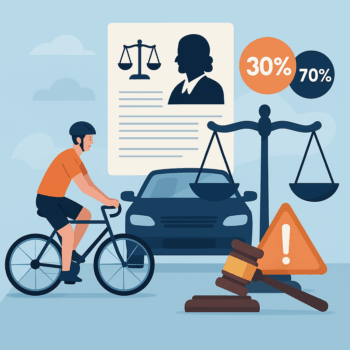
Comparative fault is a legal doctrine that determines how responsibility for an accident is shared between the parties involved. In California, the law follows a pure comparative fault rule. This means that if you are involved in an accident and are found to be partially at fault, your compensation for injuries could be reduced based on your percentage of responsibility.
For example, if you are determined to be 30% at fault for a bicycle accident, your potential recovery in damages would be reduced by 30%. This is significant because, unlike other states that have a modified comparative fault rule (where you cannot recover anything if you are more than 50% at fault), California allows you to recover damages even if you are largely at fault. However, your recovery will be diminished in proportion to the percentage of fault you carry.
Understanding this rule is vital as it can directly impact how much you are awarded in your case. Even if you share some of the blame, you are still eligible for compensation. But, it’s crucial to know how much your fault might reduce that compensation.
Founding Attorney
Timothy J. Ryan
How Does Comparative Fault Impact Bicycle Accident Claims in California?
When it comes to bicycle accidents, comparative fault can come into play in various situations. In many cases, both the cyclist and other parties, such as motorists or even pedestrians, may share some degree of responsibility for the accident. This shared responsibility is where comparative fault becomes significant.
If the investigation into your accident reveals that both you and the other party were negligent, it becomes essential to determine each party’s percentage of fault. For example, a driver may have been speeding, but you may have failed to use hand signals when making a turn. In this scenario, both parties may bear responsibility for the accident. The determination of how much each party is at fault will directly impact the compensation you are eligible to receive.
The Role of Evidence in Proving Fault
In any legal claim, evidence is crucial in determining fault. In bicycle accident cases, evidence can include police reports, witness statements, traffic camera footage, photographs of the accident scene, and medical records. The more evidence you have, the stronger your case will be.
Got a really bad head concussion and Timothy J. Ryan was amazing.” Tim helped me to stop stressing out about my case and focus my attention back on my work and family. Tim is one of the smartest men I have ever met. This personal injury law firm changed my life. They did not disappoint in any way. The entire office was professional and friendly! You can trust this firm. Highly recommend. ” - Flex Drill Tim is personable, knowledgeable in law and interested in you as a person, Tim stayed on top of my case and kept me updated frequently. His staff (Sose and Katelyn were outstanding and worked closely with me to get things done. I would recommend this law firm." - Leslie Bartimore Very efficient and professional personnel. Starting from the top to bottom. The experience was great. Being Hispanic was really happy seen how they were able to handle cases with all different ethnicities. The treatment I got from Tim and the legal assistant was beyond awesome. Super happy with the settlement and the outputs of my case. Thanks a lot Tim and Tania." - Rafael Sarabia
For instance, if there are clear signs that a driver was speeding, texting, or otherwise distracted at the time of the accident, they may be deemed primarily responsible. However, if there are factors such as improper signaling or not yielding at a crosswalk on the cyclist’s part, it will be weighed into the case.
At times, the process of gathering and presenting this evidence can be complex. This is why having a lawyer who understands how to gather and present the right type of evidence is critical to securing the best possible outcome for your case.
What Happens If You Are Partially At Fault?
If you are found to be partially at fault for the bicycle accident, your damages will be reduced in accordance with the percentage of fault assigned to you. This is important because even if you share some of the blame for the accident, you are still entitled to compensation for your injuries, as long as you were not 100% at fault.
For example, let’s say you were in a bicycle accident with a motorist. The motorist may be found to be 70% at fault for failing to yield the right of way, while you are found to be 30% at fault for not wearing a helmet. Under the pure comparative fault rule, if your total damages amount to $100,000, you would be eligible for $70,000 (after your 30% fault is subtracted).
It’s also important to note that this reduction in compensation applies to both economic damages (like medical bills and lost wages) and non-economic damages (such as pain and suffering). However, the law still allows for you to pursue these damages even if you were partly at fault, which is a relief for many cyclists who may fear that any fault on their part would negate their ability to recover.
Choosing a Personal Injury Attorney
Personal Injury Case Timeline
Related Videos
How Insurance Companies Handle Comparative Fault
Insurance companies are often involved in determining how fault is allocated in an accident. If you are making a claim against a driver’s insurance company or your own insurance for a bicycle accident, the insurer will assess the degree of fault of each party involved.
In situations where comparative fault is in play, the insurance company will likely attempt to minimize its payout by arguing that you were more at fault than you believe. They may try to gather evidence that paints you as more responsible for the accident than you actually were. This is why having a lawyer to represent you is essential. They can help defend your interests and ensure that your fault is fairly evaluated.
In some cases, a third party (like an expert witness) may be needed to help explain the degree of fault each party bears in the accident. If you find yourself in a situation where the insurance company is offering a settlement that doesn’t fully account for your damages, it might be time to discuss your case with a legal professional.
Case Results
The Importance of Legal Representation in Bicycle Accident Claims
When dealing with comparative fault in a bicycle accident, you need a skilled lawyer on your side to protect your rights and advocate for fair compensation. The legal process surrounding comparative fault can be confusing, and insurance companies are often more interested in minimizing their payouts than ensuring that you are fully compensated for your injuries.
A personal injury lawyer, especially one familiar with bicycle accident claims, can assist you in gathering the necessary evidence, challenging any unfair fault allocations, and negotiating with insurance companies on your behalf. With the right legal guidance, you can be confident that your claim will be handled properly and that you have the best chance for a favorable outcome.
At Timothy J. Ryan’s law firm, we understand the emotional and physical toll that an accident can take. We approach every case with empathy and dedication, ensuring that our clients receive the best possible legal support. If you’ve been involved in a bicycle accident and need help navigating a comparative fault case, we are here to help you. We can assist with determining fault, gathering evidence, and fighting for your right to compensation.
In conclusion, comparative fault plays a crucial role in how bicycle accident claims are handled in California. While being partially at fault for an accident doesn’t mean you can’t receive compensation, it does affect how much you can recover. Understanding how fault is determined and how it impacts your claim can be difficult, but with the right support, you can feel confident in your case.
If you’ve been involved in a bicycle accident and are facing a comparative fault situation, don’t try to navigate this complex legal terrain on your own. Reach out to Timothy J. Ryan and his team to get the guidance and representation you deserve. With our help, you can focus on your recovery while we focus on getting you the compensation you need to move forward.
To learn more about this subject click here: Common Injuries in California Bicycle Accidents: Legal and Medical Perspectives