
Back-to-school weeks bring more cars, school buses, bicycles, e-bikes, scooters, and pedestrians into the same small areas during narrow morning and afternoon windows. In Orange County, a routine school drop-off can become dangerous when a driver speeds, looks at a phone, makes an unsafe turn, passes a stopped school bus, or fails to see a child in a crosswalk.
California law requires drivers to yield to pedestrians in marked crosswalks and unmarked crosswalks at intersections. It also requires drivers to stop for school buses displaying flashing red lights in most situations. Special speed rules may apply near schools.
After a serious school-traffic accident, parents may need to address medical care, insurance claims, evidence preservation, liability, and filing deadlines. Timothy J. Ryan helps injured children and their families in Orange County understand these issues and determine what steps may protect a claim.
School-area evidence can disappear within days. Save photographs, reports, witness information, and possible video sources as soon as possible.



Why Back-to-School Traffic Creates Added Risk 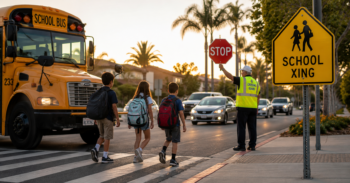
School traffic is different from ordinary commuting traffic. Parents may be searching for curbside space, children may step between parked vehicles, buses may stop repeatedly, and students may arrive by bicycle, e-bike, or scooter. Families may also be learning new routes during the first weeks of school.
Common back-to-school traffic accidents include:
- A driver turning through a crosswalk while watching oncoming traffic
• A rear-end collision in a crowded pickup line
• A child struck while entering or leaving a school bus
• A bicycle, e-bike, or scooter collision near a driveway or campus entrance
• A vehicle door opening into the path of a cyclist
• A crash caused by double parking, an illegal U-turn, or a sudden lane change
The legal analysis depends on where the crash occurred, who controlled the area, what each person was doing, and whether a road design, visibility problem, or traffic-control condition contributed.
California School-Zone Speed Rules
California Vehicle Code section 22352 generally establishes a 25 mph prima facie speed limit when a driver approaches or passes a properly posted school area while children are going to or leaving school. A prima facie limit can be challenged by evidence showing that a different speed was lawful or unlawful under the circumstances.
Under a law effective January 1, 2026, local authorities may adopt a 20 mph school-zone limit by ordinance or resolution when statutory conditions are met. A broader statewide 20 mph school-zone framework is scheduled to become operative in 2031. Drivers should follow posted signs because local limits, hours, and conditions can vary.
A posted speed limit does not permit a driver to travel at that speed when conditions make it unsafe. A driver may still be negligent by moving too fast for congestion, limited visibility, children near the roadway, or active turning movements.
Founding Attorney
Timothy J. Ryan
Crosswalks and Children Walking to School
California Vehicle Code section 21950 requires drivers to yield the right-of-way to pedestrians crossing within marked crosswalks and unmarked crosswalks at intersections. Drivers approaching a pedestrian must use due care, reduce speed, and take other action needed to protect that person.
Pedestrians must also use reasonable care. A pedestrian should not suddenly leave a curb or another place of safety and enter the path of a vehicle that is too close to stop safely.
Parents should teach children that a crosswalk does not physically stop a vehicle. Children should pause at the curb, look in both directions, make eye contact with drivers when possible, and avoid assuming that a turning driver has seen them.
For more information about fault, evidence, and damages in a pedestrian injury claim, visit:
https://www.tjryanlaw.com/orange-county-pedestrian-accident-attorney/
School Buses and Flashing Red Lights
California Vehicle Code section 22454 generally requires a driver approaching a school bus from either direction to stop when the bus is displaying flashing red lights and a stop signal arm. The driver must remain stopped until the red lights and stop signal arm stop operating.
An exception may apply when the school bus is on the other side of a divided highway or a qualifying multilane highway. The precise roadway design matters.
Children may cross in front of a bus, where they can be difficult to see. Drivers should stop early, leave space, and wait until the bus signals end before proceeding.
Got a really bad head concussion and Timothy J. Ryan was amazing.” Tim helped me to stop stressing out about my case and focus my attention back on my work and family. Tim is one of the smartest men I have ever met. This personal injury law firm changed my life. They did not disappoint in any way. The entire office was professional and friendly! You can trust this firm. Highly recommend. ” - Flex Drill Tim is personable, knowledgeable in law and interested in you as a person, Tim stayed on top of my case and kept me updated frequently. His staff (Sose and Katelyn were outstanding and worked closely with me to get things done. I would recommend this law firm." - Leslie Bartimore Very efficient and professional personnel. Starting from the top to bottom. The experience was great. Being Hispanic was really happy seen how they were able to handle cases with all different ethnicities. The treatment I got from Tim and the legal assistant was beyond awesome. Super happy with the settlement and the outputs of my case. Thanks a lot Tim and Tania." - Rafael Sarabia
Bicycles, E-Bikes, and Scooters Near Campus
Orange County students often use bicycles, e-bikes, scooters, and skateboards for short trips to school. Riders can be hard to see when drivers enter driveways, turn right, reverse from parking spaces, or open vehicle doors.
California law requires a person under 18 to wear a properly fitted and fastened approved helmet while operating or riding a bicycle, nonmotorized scooter, skateboard, or skates on a street, bikeway, or public bicycle path or trail.
Parents should also check:
- Helmet fit and condition
• Front and rear visibility
• Brakes and tire condition
• Lights and reflectors
• The child’s planned route
• Whether the child understands driveway, intersection, and door-zone risks
For information about bicycle collision claims, visit:
https://www.tjryanlaw.com/orange-county-bicycle-accident-lawyer/
Who May Be Responsible for a School-Traffic Accident?
The responsible party is not always limited to the person behind the wheel. Depending on the evidence, a claim may involve:
- A distracted, speeding, impaired, or careless driver
• A vehicle owner
• An employer whose worker caused the crash while performing job duties
• A private bus company or transportation contractor
• A public entity responsible for a dangerous road condition
• A manufacturer when defective equipment contributed
• Several parties whose conduct combined to cause the injury
A school or public agency is not automatically responsible because an accident happened near a campus. A public-entity claim may require proof of a legally recognized dangerous condition, causation, notice, and other elements. It may also involve an administrative claim deadline that is much shorter than the deadline for many ordinary injury lawsuits.
Choosing a Personal Injury Attorney
Personal Injury Case Timeline
Related Videos
What Parents Should Do After an Accident
A calm, organized response can protect a child’s health and preserve evidence.
- Call 911 when anyone may be injured or the scene remains dangerous.
- Seek medical care. Some injuries are not fully apparent at the scene, and symptoms may become clearer after the initial shock fades.
- Photograph the vehicles, crosswalk, signs, curb, sight obstructions, skid marks, bicycle or scooter, helmet, and surrounding area.
- Get contact information for drivers, witnesses, crossing guards, school staff, and bus personnel.
- Save the police report number and every school, transportation, or incident report.
- Preserve damaged clothing, backpacks, helmets, bicycles, scooters, and child-safety equipment.
- Track medical visits, symptoms, school absences, activity limits, transportation costs, and a parent’s missed work.
- Use care when speaking with insurance adjusters. An early recorded statement can create disputes before the injuries and facts are fully understood.
For a broader explanation of collision investigations and insurance claims, visit:
https://www.tjryanlaw.com/orange-county-car-accident-lawyer/
Evidence Can Disappear Quickly
School-area cases often depend on evidence that does not remain available for long. Nearby businesses, homes, buses, and schools may have camera footage, but routine deletion policies can erase recordings. Temporary signs may be moved, vehicles may be repaired, and witnesses may forget details.
An investigation may seek:
- Surveillance video
• School-bus camera footage
• Dispatch records
• Crossing-guard schedules
• School communications
• Traffic studies
• Maintenance records
• Prior complaints
• Vehicle data
• Phone records
• Medical records and expert opinions
Consider this hypothetical example. A Huntington Beach parent stops at a marked crosswalk near a school. A child begins crossing with an adult. A driver making a right turn looks left for a gap in traffic and strikes the child at low speed. The insurer later argues that the child moved unexpectedly.
Camera footage, witness statements, vehicle position, crosswalk markings, and medical records may help show whether the driver used reasonable care. The outcome would depend on the full facts and evidence.
Case Results
Medical Bills and Other Damages
A child’s injury claim may include compensation for:
- Emergency care and hospitalization
• Imaging, surgery, therapy, and medication
• Future medical treatment
• Pain and emotional harm
• Scarring or disfigurement
• Disability
• Loss of normal activities
• Other accident-related losses allowed by law
Serious injuries can affect school attendance, sports, sleep, concentration, and family routines. Compensation depends on the medical evidence, long-term outlook, available insurance, fault disputes, and the effect of the injury on the child’s life.
Uninsured or underinsured motorist coverage may apply when the responsible driver has no insurance or does not have enough insurance to cover the losses. Read more at:
https://www.tjryanlaw.com/car-accidents/uninsured-and-underinsured-motorist-coverage-california/
Deadlines Require Early Attention
California Code of Civil Procedure section 335.1 generally provides two years to file many personal injury lawsuits. Rules involving minors can affect how some deadlines are calculated, but parents should not assume that every deadline is automatically delayed.
Insurance notice requirements, evidence concerns, contractual deadlines, and claims involving public entities may require action much earlier.
California Government Code section 911.2 generally requires a claim relating to personal injury against a public entity to be presented within six months after the claim accrues. A school district, city, county, or another public body may be involved in some cases. Families should obtain advice about the deadline that applies to their specific situation.
Speak With Timothy J. Ryan About an Orange County School-Traffic Injury
A back-to-school accident can leave your family balancing medical appointments, missed classes, insurance calls, and uncertainty. Timothy J. Ryan offers free consultations to injured people and families in Orange County and nearby areas.
The firm can review available evidence, identify possible insurance coverage, explain applicable deadlines, and discuss practical next steps without promising a specific result.
Call (714) 881-8848 or visit:
https://www.tjryanlaw.com/contact-us/
This article is for informational purposes only and is not legal advice. Consult an attorney about your specific situation.